This should be welcome news to the milions of diabetes sufferers, however it's important to note the following cautions as stated in the press release:
"Exubera may affect lung function so patients need to have their lungs tested before starting Exubera, and periodically thereafter, as directed by a healthcare provider. The test involves exhaling into a measuring device. Exubera is not recommended for people that have chronic lung disease (such as asthma, chronic obstructive pulmonary disease or emphysema). Also, Exubera should not be used at all by people with unstable or poorly controlled lung disease."
NEW YORK, January 27 -- Pfizer Inc said today that Exubera® (insulin human [rDNA origin]) Inhalation Powder has been approved by the U.S. Food and Drug Administration for the treatment of adults with type 1 and type 2 diabetes. Exubera was found in clinical trials to be as effective as short-acting insulin injections, and to significantly improve blood sugar control when added to diabetes pills. Exubera, which is expected to be available for patients by mid-year, is the first inhaled form of insulin and the first insulin option that does not need to be administered by injection in the United States.
"Exubera is a major, first-of-its-kind, medical breakthrough that marks another critical step forward in the treatment of diabetes, a disease that has taken an enormous human and economic toll worldwide," said Hank McKinnell, chairman and chief executive officer of Pfizer. "The global incidence of diabetes is currently at epidemic levels. Millions of patients are not achieving or maintaining acceptable blood sugar levels, despite the availability of current therapies. Exubera meets a critical medical need by offering a highly effective and needle-free alternative to diabetes pills and insulin injections to manage this complicated, debilitating disease."
Exubera is a rapid-acting, dry powder human insulin that is inhaled through the mouth into the lungs prior to eating, using the handheld Exubera Inhaler. The Exubera inhaler weighs four ounces and, when closed, is about the size of an eyeglass case. The unique Exubera Inhaler produces in its chamber a cloud of insulin powder, which is designed to pass rapidly into the bloodstream to regulate the body's blood sugar levels.
Exubera Meets Medical Need
"Many people who could benefit from insulin are fearful of injections, so they delay treatment five years or ten years, placing them at risk for serious complications. Now, for the first time patients can improve blood sugar control with fewer or no painful injections," said Dr. William Cefalu, Exubera investigator and chief of the division of nutrition and chronic diseases at the Pennington Biomedical Research Center, a campus of the Louisiana State University System, in Baton Rouge... Full News Release
Saturday, January 28, 2006


Friday, January 27, 2006
Researchers find effective, cheap treatment for cystic fibrosis lung disease
The following two news releases may offer new hope for Cystic Fibrosis patients. A must read for CF families.
From the University of North Carolina at Chapel Hill
CHAPEL HILL, Jan. 18, 2006 -- Working half a world away from each other, two teams of medical scientists have identified what they believe is a simple, effective and inexpensive treatment to reduce lung problems associated with cystic fibrosis, the leading fatal genetic illness among whites.
The new therapy, identified through studies supported chiefly by the Cystic Fibrosis Foundation and the National Heart, Lung and Blood Institute, also appears to be safe and easy to take.
By inhaling a saltwater aerosol solution almost twice as salty as the Atlantic Ocean for between 10 and 15 minutes at least twice a day, young patients should be able to avoid a significant part of the damage the disease causes to their lungs, the researchers said. That’s because the aerosolized saltwater restores the thin lubricant layer of water that normally coats airway surfaces. This water layer promotes the clearance of the naturally occurring mucus the body uses to trap harmful bacteria, viruses and other foreign particles...
Full news release
From The Cystic Fibrosis Foundation
Bethesda, MD, January 18, 2006 —An observation by surfers in
Australia has led to a simple, inexpensive hypertonic saline therapy. This concentrated saltwater solution improves airway clearance for patients with cystic fibrosis (CF), according to research reported in the Jan. 19 issue of the New England Journal of Medicine.
The idea for the study, supported by the Cystic Fibrosis Foundation, began when the Australian surfers with CF told their doctors that their airways felt clearer after exposure to the salt spray. The medical team was aware of some evidence that in CF, salt is depleted from the liquid that lines the airways. The team thus hypothesized that sterile saltwater may be a useful therapy. They were right. Now CF patients worldwide may benefit from this “low tech” treatment... Full news release
From the University of North Carolina at Chapel Hill
CHAPEL HILL, Jan. 18, 2006 -- Working half a world away from each other, two teams of medical scientists have identified what they believe is a simple, effective and inexpensive treatment to reduce lung problems associated with cystic fibrosis, the leading fatal genetic illness among whites.
The new therapy, identified through studies supported chiefly by the Cystic Fibrosis Foundation and the National Heart, Lung and Blood Institute, also appears to be safe and easy to take.
By inhaling a saltwater aerosol solution almost twice as salty as the Atlantic Ocean for between 10 and 15 minutes at least twice a day, young patients should be able to avoid a significant part of the damage the disease causes to their lungs, the researchers said. That’s because the aerosolized saltwater restores the thin lubricant layer of water that normally coats airway surfaces. This water layer promotes the clearance of the naturally occurring mucus the body uses to trap harmful bacteria, viruses and other foreign particles...
Full news release
From The Cystic Fibrosis Foundation
Bethesda, MD, January 18, 2006 —An observation by surfers in
Australia has led to a simple, inexpensive hypertonic saline therapy. This concentrated saltwater solution improves airway clearance for patients with cystic fibrosis (CF), according to research reported in the Jan. 19 issue of the New England Journal of Medicine.
The idea for the study, supported by the Cystic Fibrosis Foundation, began when the Australian surfers with CF told their doctors that their airways felt clearer after exposure to the salt spray. The medical team was aware of some evidence that in CF, salt is depleted from the liquid that lines the airways. The team thus hypothesized that sterile saltwater may be a useful therapy. They were right. Now CF patients worldwide may benefit from this “low tech” treatment... Full news release
Thursday, January 26, 2006
Major advance in diabetes treatment
This announcement from Pfizer indicating that the new inhaled form of insulin, Exubera, has been approved by the European Commission is terrific news for those affected by diabetes. Hopefully North American approvals will be coming soon.
NEW YORK, January 26 -- Pfizer Inc said today that the European Commission has approved Exubera (inhaled human insulin) for the treatment of adults with type 1 and type 2 diabetes. Exubera is the first non-injectable, inhalable form of insulin to be approved since the discovery of insulin in the 1920s, and represents a major advance in diabetes treatment.
According to the World Health Organization (WHO), diabetes has reached epidemic proportions and affects approximately 48 million people in Europe alone. People with diabetes often suffer from debilitating complications due to uncontrolled blood sugar levels including heart disease, amputation, blindness and kidney failure. The direct healthcare costs associated with diabetes are estimated to be around $286 billion worldwide, with the majority of these costs linked to treating diabetes-related complications.
Since its discovery more than 80 years ago, insulin has been the gold standard treatment for diabetes. In order to achieve tight blood sugar control, insulin is often administered before meals to mimic the body's natural insulin response to food. Healthcare providers and patients have been reluctant to initiate or intensify insulin therapy when it is required due to the need for daily injections.
"Exubera is a major, first-of-its-kind, medical breakthrough that marks another critical step forward in the treatment of diabetes, a disease that has taken an enormous human and economic toll worldwide," said Hank McKinnell, Pfizer chairman and chief executive officer. "The global incidence of diabetes is currently at epidemic levels. Millions of patients are not achieving or maintaining acceptable blood sugar levels, despite the availability of current therapies. Exubera meets a critical medical need by offering a highly effective and needle-free alternative to diabetes pills and insulin injections to manage this complicated, debilitating disease."
Exubera is a fast-acting, dry powder formulation of human insulin that is inhaled into the lungs via the mouth before meals using a simple-to-use, hand-held device that does not require batteries or electricity. The device, which weighs four ounces and is about the size of a carrying case for a pair of eye glasses, is designed to deliver an accurate and precise dose of insulin each time it is used.
Read the full press release
NEW YORK, January 26 -- Pfizer Inc said today that the European Commission has approved Exubera (inhaled human insulin) for the treatment of adults with type 1 and type 2 diabetes. Exubera is the first non-injectable, inhalable form of insulin to be approved since the discovery of insulin in the 1920s, and represents a major advance in diabetes treatment.
According to the World Health Organization (WHO), diabetes has reached epidemic proportions and affects approximately 48 million people in Europe alone. People with diabetes often suffer from debilitating complications due to uncontrolled blood sugar levels including heart disease, amputation, blindness and kidney failure. The direct healthcare costs associated with diabetes are estimated to be around $286 billion worldwide, with the majority of these costs linked to treating diabetes-related complications.
Since its discovery more than 80 years ago, insulin has been the gold standard treatment for diabetes. In order to achieve tight blood sugar control, insulin is often administered before meals to mimic the body's natural insulin response to food. Healthcare providers and patients have been reluctant to initiate or intensify insulin therapy when it is required due to the need for daily injections.
"Exubera is a major, first-of-its-kind, medical breakthrough that marks another critical step forward in the treatment of diabetes, a disease that has taken an enormous human and economic toll worldwide," said Hank McKinnell, Pfizer chairman and chief executive officer. "The global incidence of diabetes is currently at epidemic levels. Millions of patients are not achieving or maintaining acceptable blood sugar levels, despite the availability of current therapies. Exubera meets a critical medical need by offering a highly effective and needle-free alternative to diabetes pills and insulin injections to manage this complicated, debilitating disease."
Exubera is a fast-acting, dry powder formulation of human insulin that is inhaled into the lungs via the mouth before meals using a simple-to-use, hand-held device that does not require batteries or electricity. The device, which weighs four ounces and is about the size of a carrying case for a pair of eye glasses, is designed to deliver an accurate and precise dose of insulin each time it is used.
Read the full press release
Wednesday, January 25, 2006
Inhaled cyclosporine may stave off long-term rejection and improve survival
As a lung transplant patient anything that offers hope for the prevention of long-term rejection and improves survival is something that catches my attention. As the investigators state, more studies are needed but these results should be received enthusiastically.
From Transplant Living
January 12, 2006
NEW YORK (Reuters Health) - Use of inhaled cyclosporine, in addition to other immune-suppressing drugs in pill form, does not help prevent the early rejection of lung transplants, but it does seem to stave off long-term rejection and improve survival, according to a report in The New England Journal of Medicine.
Conventional immunosuppressive drugs do not prevent long-term rejection after lung transplantation, lead author Dr. Aldo T. Iacono, from the University of Maryland in Baltimore, and colleagues note. Delivery of cyclosporine directly to the lung transplant, through the use of an inhaler, may help cut the rates of both early and long-term rejection.
Full news article
From Transplant Living
January 12, 2006
NEW YORK (Reuters Health) - Use of inhaled cyclosporine, in addition to other immune-suppressing drugs in pill form, does not help prevent the early rejection of lung transplants, but it does seem to stave off long-term rejection and improve survival, according to a report in The New England Journal of Medicine.
Conventional immunosuppressive drugs do not prevent long-term rejection after lung transplantation, lead author Dr. Aldo T. Iacono, from the University of Maryland in Baltimore, and colleagues note. Delivery of cyclosporine directly to the lung transplant, through the use of an inhaler, may help cut the rates of both early and long-term rejection.
Full news article
Friday, January 20, 2006
Catholic priests hear the organ and tissue donation story
As you know, I've been actively promoting organ and tissue donation awareness via speaking engagements at churches, service clubs, social organizations and businesses. The message has been generally well received but none more so than today's talk with Catholic priests who attended a meeting at Our Lady of Lourdes church in downtown Toronto. It was heartwarming to see such keen interest from these respected religious leaders who touch the lives of so many and are in a position to inform a great number of people about organ and tissue donation.
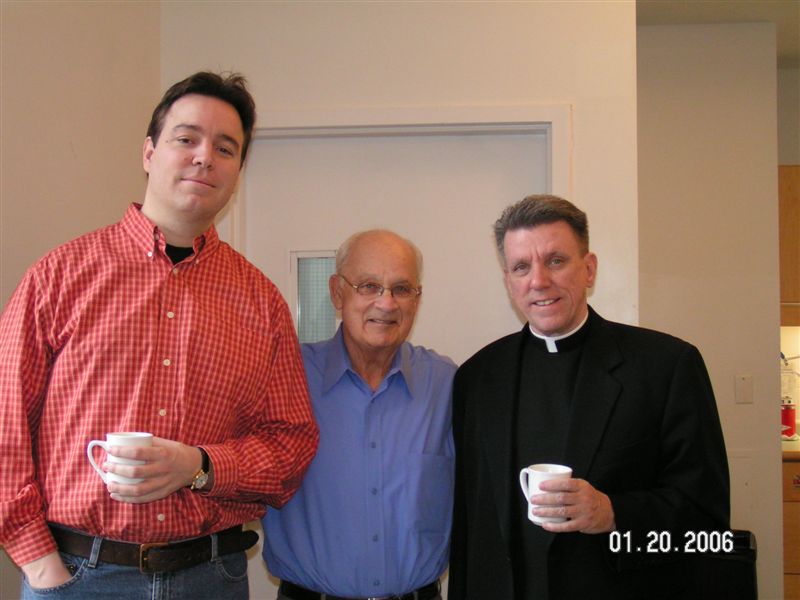
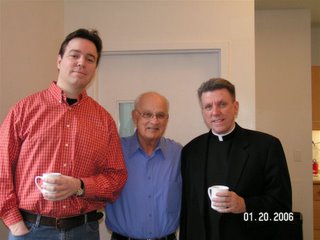 Father Pat O'Dea, Chair, Zone 1 Catholic Parishes, Dicoese of Toronto, organized the event with Trillium Gift of Life Network (TGLN). Pictured with Father Pat are Brian Kellow, educator with TGLN and myself.
I spoke about my lung transplant experience and Brian Kellow gave a comprehensive and well received overview of organ and tissue donation in Ontario and the role that Trillium Gift of Life Network (TGLN) has in planning, promoting, coordinating and supporting activities related to organ and tissue donation, education and research.
The priests asked many questions and some commented that the personal story of a transplant recipient had a huge impact on their thinking and motivation to promote organ and tissue donation. If your group or organization would like to hear the organ donation message TGLN will be very happy to provide speakers and support for your event. Contact Trillium Gift of Life Network
 Father Pat O'Dea, Chair, Zone 1 Catholic Parishes, Dicoese of Toronto, organized the event with Trillium Gift of Life Network (TGLN). Pictured with Father Pat are Brian Kellow, educator with TGLN and myself.
I spoke about my lung transplant experience and Brian Kellow gave a comprehensive and well received overview of organ and tissue donation in Ontario and the role that Trillium Gift of Life Network (TGLN) has in planning, promoting, coordinating and supporting activities related to organ and tissue donation, education and research.
The priests asked many questions and some commented that the personal story of a transplant recipient had a huge impact on their thinking and motivation to promote organ and tissue donation. If your group or organization would like to hear the organ donation message TGLN will be very happy to provide speakers and support for your event. Contact Trillium Gift of Life Network
Wednesday, January 18, 2006
Magna promotes Organ & Tissue Donation
 Presstran Industries, St. Thomas, Ontario is one of the Magna Group of companies manufacturing auto parts. It was my pleasure to be part of a Trillium Gift of Life Network presentation that was heard by almost all of their 800 employees in a series of staggered meetings January 17th to accommodate various shifts. Shown are Sam Barraco, General Manager and Lisa Borg, Human Resources Manager, who are strong supporters of organ and tissue donation awareness.
Being an advocate for organ donation awareness has given me the opportunity to not only deliver the message but I've also met some great people and enjoyed new learning experiences that have enhanced my life. Yesterday my visit to Presstran turned out to be one such experience.
In previous articles I've written about how royally I'd been treated by the medical community. From the moment I arrived at Presstran I was greeted warmly and in a friendly manner by everyone that met me. I wrote some of their names down; Donna Wood, Char (didn't get the last name), Gina Alexandre, Hans Szlavik, Lisa Borg, Joanna Mudge and general manager Sam Barraco.
In addition to the friendliness of the staff, another thing that made a big impression on me was the company's emphasis on safety and cleanliness. I have never been in a manufacturing plant that was so absolutely clean. It's a huge, metal stamping and fabricating operation yet everything was clean, neat and tidy (including the employees!). Safety is number one at Presstran; no one is allowed in the plant area without safety glasses, safety shoes and ear plugs. This rule is rigidly enforced.
Our organ and tissue donation message was very well received. Brian Kellow, Trillum educator and Rizwana Ramzanali, kidney/pancreas transplant recipient, were the other Trillium Gift of Life Network participants.
Between sessions, General Manager Sam Barraco, Assistant General Manager Hans Szlavik and Human Resorces Manager Lisa Borg spent quite a long time chatting with me and showed a genuine interest in my transplant story as well as the importance of promoting organ and tissue donation awareness. Hats off to Presstran Industries. It's no wonder that Magna is such a successful auto parts manufacturer. They've got it right, in my opinion.
Tuesday, January 17, 2006
Buy a raffle ticket to help heart transplant research
The Heart Transplant Patients group, HeartLinks, will be selling raffle tickets in the Eaton lobby of the Toronto General Hospital between the hours of 10am and 3pm on January 19th and 26th, February 2nd, 9th and 14th (the draw will take place at 1:30pm on the 14th). All proceeds will go to Heart Transplant medical research and related projects.
The heart group has always been very supportive of our lung transplant initiatives and I encourage you to support this worthwhile cause of theirs. They have worked very hard to get some great prizes and sponsorship (more than 30 at last count) which include hotel stays, tv sets, cameras, Raptors and Maple Leafs tickets, gift certificates for retail stores and restaurants, plus much more. A full list is posted throughout the hospital.
The draw will take place in the Eaton Lobby, Toronto General Hospital, Valentine’s Day, February 14th at 1:30pm.
Tickets are $2 each, 3 for $5 or a booklet of 20 for $30. They can be purchased directly from the Transplant Clinic on the 12th floor, NCSB. You can also get tickets by phone or email: 416-351-0793 or Raffle Tickets
If you would like to help sell tickets your support will be appreciated. Let the organizers know ASAP at the above contacts.
The heart group has always been very supportive of our lung transplant initiatives and I encourage you to support this worthwhile cause of theirs. They have worked very hard to get some great prizes and sponsorship (more than 30 at last count) which include hotel stays, tv sets, cameras, Raptors and Maple Leafs tickets, gift certificates for retail stores and restaurants, plus much more. A full list is posted throughout the hospital.
The draw will take place in the Eaton Lobby, Toronto General Hospital, Valentine’s Day, February 14th at 1:30pm.
Tickets are $2 each, 3 for $5 or a booklet of 20 for $30. They can be purchased directly from the Transplant Clinic on the 12th floor, NCSB. You can also get tickets by phone or email: 416-351-0793 or Raffle Tickets
If you would like to help sell tickets your support will be appreciated. Let the organizers know ASAP at the above contacts.
Monday, January 16, 2006
In Praise of The Lung Transplant Team at Toronto General Hospital
 I've come a long way since these first days of my "second chance". This April 20th will mark the four-year anniversary of my single-lung transplant. And what a wonderful four years it's been! I experienced the miracle of receiving life from where there was virtually no life and this has changed me forever. I feel better today than I have for many years with boundless energy and a feeling of overall well being. I will be eternally grateful to my donor and his or her family and the wonderful Lung Transplant Team at the Toronto General Hospital division of the University Health Network.
This year's Rose Parade theme was "It's Magical" and the Donate Life float's theme was "Life Transformed". This could not be more apt or appropriate, at least in my case. My transplant touched my life by giving me the "Gift of Life". It has transformed me physically, emotionally and spiritually. My lung transplant has had a profound, and yes, magical, impact on my life, as I'm sure organ and tissue transplantation has helped hundreds of thousands of people regain their health with the same impact on their lives, families and friends. Speaking of friends, many of the best friends I have ever known I only met since my transplant, through the special bond that exists in our transplant community.
A noted cardiologist said on TV how impressed he was with the monitoring and follow-up transplant patients receive and how he wished all patients could have the same attention.
That got me to thinking about the follow-up I've received as a pre and post lung-transplant patient and it's been absolutely second to none. I have never been more impressed with any group more than with The Lung Transplant Team at Toronto General Hospital, from the doctors to the nurses, transplant coordinators, the Support Group, physiotherapists, respiratory and pulmonary function technologists, and other support staff and technicians. This also includes the staff at Toronto Western Hospital where I have various tests and procedures from time to time. At first, because I was treated so royally, I thought they might have mistaken me for a Head of State or other V.I.P. until I learned that every patient is treated this way. It is very obvious they are not just doing a job, but have a compassionate interest and dedication to their patient's optimal recovery and well being.
In addition to my regular clinics and visits, I received a steady stream of calls and messages from "the team" since my discharge. This was further emphasized for me recently; I missed getting my monthly blood work done when it was scheduled and sure enough, my transplant coordinator was on the phone to find out why. With all this attention it would be easy to think I was the only patient they had. But I happen to know The Lung Transplant Team has a caseload of hundreds of patients at various stages of follow-up and treatment. How they do it I don't know, but it must involve a lot of hours, passion for their career and hard work.
Not only have I been given the gift of life but is very comforting to know that there is a team of people monitoring and watching over me to make sure that my gift of a single-lung transplant survives and stays part of me for a long time to come. So, whether you are waiting for a transplant, post-transplant or a support person or friend, I feel you and yours could not be in better hands than those of the Toronto General Hospital Lung Transplant Team!
Friday, January 13, 2006
New hope for idiopathic pulmonary fibrosis patients?
When I was diagnosed with idiopathic pulmonary fibrosis in the fall of 1999 there was no hope for slowing or stopping the progression of the disease. The only option was a lung transplant.
The following news release describes a University of Pittsburgh study that suggests standard anti-inflammatory therapy may not be appropriate for many interstitial lung disease patients such as those with idiopathic pulmonary fibrosis (IPF) and a related study suggests that a protein known as osteopontin may be a target for therapy.
The investigators suggest that if their findings hold up in further, larger studies, doctors may be able to slow or stop the progression of this deadly disease. This is probably a long way from reality but at least there's a glimmer of hope for the future.
PITTSBURGH, Jan. 11, 2006 – In an article in the Jan. 15 issue of the American Journal of Respiratory Critical Care Medicine, University of Pittsburgh researchers report that a serious, life-threatening form of pulmonary fibrosis, called idiopathic pulmonary fibrosis, lacks all the hallmarks of inflammation and is probably unnecessarily treated with anti-inflammatory drugs. Moreover, in a related study, (see below) the investigators identified a protein found in excess amounts in the lung tissue of patients with idiopathic pulmonary fibrosis, which may be a more appropriate target for therapy.
Interstitial lung disease describes a diverse set of chronic lung conditions that often have strikingly similar symptoms but different clinical courses. However, all are characterized by differing degrees of progressive scarring of lung tissue between the air sacs, or the interstitium. With repeated damage, the interstitium becomes thickened and stiff, or fibrotic, making it increasingly difficult for the individual to breathe. Some forms of interstitial lung disease, particularly idiopathic pulmonary fibrosis, which has no known cause, have a very high death rate due to respiratory failure. Effective treatment, however, is complicated by the fact that a definitive diagnosis often requires a lung biopsy.
“Unfortunately, many patients do not receive lung biopsies. As a result, about one-third of patients who come to our clinic have previously been misdiagnosed, and many have been treated with the wrong medications,” explained James Dauber, M.D., medical director of the University of Pittsburgh’s Dorothy P. and Richard P. Simmons Center for Interstitial Lung Disease, and professor of medicine, division of pulmonary, allergy and critical care medicine...Read the full news release
This release also refers to another study offering additional potential hope for IPF patients. It goes on to say:
"Although there currently is no effective treatment for idiopathic pulmonary fibrosis, results of another study suggest help may soon be on the way. Dr. Kaminski and his colleagues reported in the Sept. 6 online edition of PLoS Medicine that idiopathic pulmonary fibrosis lung tissue samples display an “over-abundance” of a protein known as osteopontin, which other studies have implicated in the growth and progression of tumors. In further examining the potential role of osteopontin in idiopathic pulmonary fibrosis, Dr. Kaminski’s group found that it directly increases the proliferation and movement of fibroblasts, cells centrally involved in lung fibrosis"... Full News Release
The following news release describes a University of Pittsburgh study that suggests standard anti-inflammatory therapy may not be appropriate for many interstitial lung disease patients such as those with idiopathic pulmonary fibrosis (IPF) and a related study suggests that a protein known as osteopontin may be a target for therapy.
The investigators suggest that if their findings hold up in further, larger studies, doctors may be able to slow or stop the progression of this deadly disease. This is probably a long way from reality but at least there's a glimmer of hope for the future.
PITTSBURGH, Jan. 11, 2006 – In an article in the Jan. 15 issue of the American Journal of Respiratory Critical Care Medicine, University of Pittsburgh researchers report that a serious, life-threatening form of pulmonary fibrosis, called idiopathic pulmonary fibrosis, lacks all the hallmarks of inflammation and is probably unnecessarily treated with anti-inflammatory drugs. Moreover, in a related study, (see below) the investigators identified a protein found in excess amounts in the lung tissue of patients with idiopathic pulmonary fibrosis, which may be a more appropriate target for therapy.
Interstitial lung disease describes a diverse set of chronic lung conditions that often have strikingly similar symptoms but different clinical courses. However, all are characterized by differing degrees of progressive scarring of lung tissue between the air sacs, or the interstitium. With repeated damage, the interstitium becomes thickened and stiff, or fibrotic, making it increasingly difficult for the individual to breathe. Some forms of interstitial lung disease, particularly idiopathic pulmonary fibrosis, which has no known cause, have a very high death rate due to respiratory failure. Effective treatment, however, is complicated by the fact that a definitive diagnosis often requires a lung biopsy.
“Unfortunately, many patients do not receive lung biopsies. As a result, about one-third of patients who come to our clinic have previously been misdiagnosed, and many have been treated with the wrong medications,” explained James Dauber, M.D., medical director of the University of Pittsburgh’s Dorothy P. and Richard P. Simmons Center for Interstitial Lung Disease, and professor of medicine, division of pulmonary, allergy and critical care medicine...Read the full news release
This release also refers to another study offering additional potential hope for IPF patients. It goes on to say:
"Although there currently is no effective treatment for idiopathic pulmonary fibrosis, results of another study suggest help may soon be on the way. Dr. Kaminski and his colleagues reported in the Sept. 6 online edition of PLoS Medicine that idiopathic pulmonary fibrosis lung tissue samples display an “over-abundance” of a protein known as osteopontin, which other studies have implicated in the growth and progression of tumors. In further examining the potential role of osteopontin in idiopathic pulmonary fibrosis, Dr. Kaminski’s group found that it directly increases the proliferation and movement of fibroblasts, cells centrally involved in lung fibrosis"... Full News Release
Monday, January 09, 2006
Important dates for our transplant community in 2006
Please make a note of the following dates in your 2006 calendars. More information and details are provided by the links.
April 23 to April 30 National Organ and Tissue Donation Week in Canada
April is National Donate Life Month in the United States
Birthday Ball Wednesday, April 26, 2006
Transplant Open Golf Wednesday, June 7, 2006
US Transplant Games, Louisville, June 16-21, 2006
Lung Transplant Picnic June 18/06
Canadian Transplant Games, Edmonton, Aug 8-13, 2006
The following is for your 2007 advance planning.
World Transplant Games 2007, Bangkok Aug 25-Sept 3
The following is for your 2007 advance planning.
Saturday, December 31, 2005
"For Auld Lang Syne"
Millions of people will sing "For Auld Lang Syne" as we ring in the New Year tonight and most will not know the exact meaning of the words. Here's a link to the most popular version of Auld Lang Syne and a translation that shows everytime we sing 'for auld lang syne' we are simply saying "for old long ago".
I Wish You a Very Happy and Prosperous Year 2006
Friday, December 30, 2005
Donate Life Float in 2006 Rose Parade
The 117th Rose Parade, themed It's Magical, will take place on Monday, January 2, 2006 at 8:00am PST featuring spirited marching bands from throughout the nation, majestic floral floats and high-stepping equestrian units.
For millions of us, the Rose Parade has been must TV viewing as we rest and relax after the holidays and New Year's eve celebrations. Since 2004 the Rose Parade has taken on special meaning for our transplant community with the entry of the Donate Life float.
Lung transplant recipient Gary Foxen suggested the idea of a Donate Life Float entry in the Rose Parade. In 1999, suffering from severe emphysema, Gary Foxen received a lung transplant. A couple years later, Gary wrote the letter originally suggesting the entry of a Donate Life-themed float in the Rose Parade as "a way to repay society for this wonderful gift" of life. Last June, Gary was honored with the Coalition on Donation’s James M. Wolf Award for his "inspiration and commitment to increasing organ and tissue donation." Gary is a rider on this year's float.
The Donate Life float and its 23 riders represent millions of people touched by organ and tissue donation, including donor families, living donors, transplant recipients and transplant candidates.
 News from Transplant Living
2006 Donate Life Rose Parade Float Features 'Life Transformed' by Organ and Tissue Donation
Los Angeles, CA -- A nationwide partnership of organizations, united to inspire all people to "Donate Life: through organ and tissue donation, unveiled its 2006 Rose Parade float design June 30, 2005 at the Association of Organ Procurement Organizations (AOPO) annual meeting in Los Angeles.
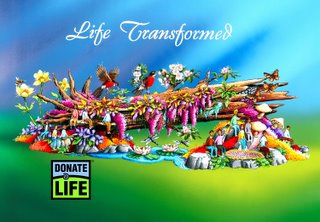
The 2006 Donate Life Rose Parade float, themed Life Transformed, will mark the third appearance of organ donors, donor family members and transplant recipients in America's New Year Celebration. The float's 22 riders--whose lives, families and communities have undergone a physical, emotional and spiritual transformation through being touched by organ and tissue donation--will be surrounded by new life that has sprung forth from the shelter of a fallen tree. The riders will hail from communities throughout the nation, including California, Illinois, New York, Ohio and Oklahoma.
The Donate Life float adds an emotional dimension to the Tournament of Roses Parade theme, It's Magical. "A life touched by organ and tissue donation and transplantation is a life transformed," said Bryan Stewart, chairman of the Donate Life Rose Parade Float organizing committee and director of communications for OneLegacy. "While organ and tissue transplantation helps hundreds of thousands of people regain their health each year, giving and receiving the gift of life has a profound--many would say magical--impact on the lives, families and communities it touches." Full Press Release
For more information:
Official Float Web Site
Official Tournament of Roses Web Site
For millions of us, the Rose Parade has been must TV viewing as we rest and relax after the holidays and New Year's eve celebrations. Since 2004 the Rose Parade has taken on special meaning for our transplant community with the entry of the Donate Life float.

Lung transplant recipient Gary Foxen suggested the idea of a Donate Life Float entry in the Rose Parade. In 1999, suffering from severe emphysema, Gary Foxen received a lung transplant. A couple years later, Gary wrote the letter originally suggesting the entry of a Donate Life-themed float in the Rose Parade as "a way to repay society for this wonderful gift" of life. Last June, Gary was honored with the Coalition on Donation’s James M. Wolf Award for his "inspiration and commitment to increasing organ and tissue donation." Gary is a rider on this year's float.
The Donate Life float and its 23 riders represent millions of people touched by organ and tissue donation, including donor families, living donors, transplant recipients and transplant candidates.
 News from Transplant Living
2006 Donate Life Rose Parade Float Features 'Life Transformed' by Organ and Tissue Donation
Los Angeles, CA -- A nationwide partnership of organizations, united to inspire all people to "Donate Life: through organ and tissue donation, unveiled its 2006 Rose Parade float design June 30, 2005 at the Association of Organ Procurement Organizations (AOPO) annual meeting in Los Angeles.
The 2006 Donate Life Rose Parade float, themed Life Transformed, will mark the third appearance of organ donors, donor family members and transplant recipients in America's New Year Celebration. The float's 22 riders--whose lives, families and communities have undergone a physical, emotional and spiritual transformation through being touched by organ and tissue donation--will be surrounded by new life that has sprung forth from the shelter of a fallen tree. The riders will hail from communities throughout the nation, including California, Illinois, New York, Ohio and Oklahoma.
The Donate Life float adds an emotional dimension to the Tournament of Roses Parade theme, It's Magical. "A life touched by organ and tissue donation and transplantation is a life transformed," said Bryan Stewart, chairman of the Donate Life Rose Parade Float organizing committee and director of communications for OneLegacy. "While organ and tissue transplantation helps hundreds of thousands of people regain their health each year, giving and receiving the gift of life has a profound--many would say magical--impact on the lives, families and communities it touches." Full Press Release
For more information:
Official Float Web Site
Official Tournament of Roses Web Site
Wednesday, December 28, 2005
Canadian Transplant Games, Edmonton, Alberta August 8th to 13th, 2006
The City of Edmonton is hosting the 2006 Canadian National Transplant Games. As much as the Games is an athletic event that calls attention to the success of organ and tissue transplantation, it is also a celebration of life among recipients, their families and friends. Athletes compete at an extraordinarily high level, demonstrating the physical success of transplant surgery and the need to increase organ donation. More..Canadian Transplant Association, Alberta Edmonton Transplant Games Aug 8-13, 2006
Tuesday, December 27, 2005
U.S. Transplant Games June 16-21, 2006 Louisville, KY
The U.S. Transplant Games is a four-day athletic competition among recipients of organ transplants. Competition in the U.S. Transplant Games is open to anyone who has received a lifesaving solid organ transplant--heart, liver, kidney, lung, and pancreas. Bone marrow recipients are also eligible to participate. As much as the Games is an athletic event that calls attention to the success of organ and tissue transplantation, it is also a celebration of life among recipients, their families and friends. More..Transplant Games
Sunday, December 25, 2005
April is National Donate Life Month in the U.S.
Now is the time to start planning activities in your community.
The History of National Donate Life Month (observed in April)
In 2003, President Bush first announced that the month of April will be observed as National Donate Life Month, a time to raise public awareness of the critical need for organ, tissue, marrow, and blood donation.
Originally known as National Organ and Tissue Donor Awareness Week and celebrated for one week in April, that observance was the result of smaller, independent efforts around the Nation to recognize the altruism and generosity of organ and tissue donors.
In 1983, the Congress of the United States "authorized and requested" the President to "issue a Proclamation designating April 22 through April 29, 1984 as National Organ Donation Awareness Week." Aware that many more tissue donations are made each year than organ donations, "Tissue" was soon added to the name, and the third full week of April became the traditional time of observance.
Over the years, many participating organizations and individuals found it restrictive to limit special donation awareness efforts to one week in April-especially as the week often conflicted with other observances such as National Volunteer Week, or at times, with Passover or Holy Week.
The change to a month-long observance of "National Donate Life Month" underscores the importance of donation of not only organs and tissues, but also marrow and blood. Having a month focused upon donation awareness and donation also gives donation and transplant organizations more time to sponsor public awareness activities in their communities.
The History of National Donate Life Month (observed in April)
In 2003, President Bush first announced that the month of April will be observed as National Donate Life Month, a time to raise public awareness of the critical need for organ, tissue, marrow, and blood donation.
Originally known as National Organ and Tissue Donor Awareness Week and celebrated for one week in April, that observance was the result of smaller, independent efforts around the Nation to recognize the altruism and generosity of organ and tissue donors.
In 1983, the Congress of the United States "authorized and requested" the President to "issue a Proclamation designating April 22 through April 29, 1984 as National Organ Donation Awareness Week." Aware that many more tissue donations are made each year than organ donations, "Tissue" was soon added to the name, and the third full week of April became the traditional time of observance.
Over the years, many participating organizations and individuals found it restrictive to limit special donation awareness efforts to one week in April-especially as the week often conflicted with other observances such as National Volunteer Week, or at times, with Passover or Holy Week.
The change to a month-long observance of "National Donate Life Month" underscores the importance of donation of not only organs and tissues, but also marrow and blood. Having a month focused upon donation awareness and donation also gives donation and transplant organizations more time to sponsor public awareness activities in their communities.
Seasons Greetings
Wishing you the happiest of Christmases and Hanukkahs and Kwanzaas and Festivi, a beautiful holiday season and a new year of peace and happiness. Merv.
Friday, December 23, 2005
Reviews of Blogs
The Health Care Blog The Wall Street Journal says this is a “must-read” blog. It is hosted by Matthew Holt, a healthcare consultant, researcher, and strategist. The site is frequented by many industry and information tech professionals but also by many doctors, students, and patients. This blog has extensive links to other health and medical blogs that Holt rates highly. I especially liked the comparisons to health care systems around the world as the debate continues about our's here in Canada.
A Chance to Cut Is a Chance to Cure
A perspective on medical and other issues from a general surgeon. A highly recommended site with many excellent links.
Kristy Mitton
Kristy, 23, has Cystic Fibrosis and is waiting for a lung & liver transplant at Toronto General Hospital. Her passion is horses and she hopes to be able to enjoy them for many years to come. Her blog is a plea for organ donation.
Medicine and Man
Putting medicine into perspective. Continuously updated by a doctor practicing in India. Excellent and extensive links.
Kidney Notes
Notes on Medicine, Science & Technology from a Nephrologist in New York City. Well written and thoughtful posts. Extensive links. Highly recommended.
Slaying The Fat Monster
This is an excellent diet & nutrition blog.
Healthwise, Agewise
How to grow old healthfully and gracefully. A brother and sister publish this excellent blog with advice on lifestyle, diet and excercise. He is a physics professor and she is a medical doctor.
Breast Cancer Central
The latest information and resources for survivors and the ones who love them.
Two Hands
Jeannette from California is publicly sharing her breast cancer experience in the hope of educating people about breast cancer and how it impacts a person emotionally, spiritually, psychologically, and physically. Good links also.
Young Savannah's Liver Transplant
The story of a young liver transplant recipient who received a 2nd transplant December 9, 2004 and how this has brought economic hardship on a U.S. family. A photo of her 6 year-old donor is posted on the blog.
A Chance to Cut Is a Chance to Cure
A perspective on medical and other issues from a general surgeon. A highly recommended site with many excellent links.
Kristy Mitton
Kristy, 23, has Cystic Fibrosis and is waiting for a lung & liver transplant at Toronto General Hospital. Her passion is horses and she hopes to be able to enjoy them for many years to come. Her blog is a plea for organ donation.
Medicine and Man
Putting medicine into perspective. Continuously updated by a doctor practicing in India. Excellent and extensive links.
Kidney Notes
Notes on Medicine, Science & Technology from a Nephrologist in New York City. Well written and thoughtful posts. Extensive links. Highly recommended.
Slaying The Fat Monster
This is an excellent diet & nutrition blog.
Healthwise, Agewise
How to grow old healthfully and gracefully. A brother and sister publish this excellent blog with advice on lifestyle, diet and excercise. He is a physics professor and she is a medical doctor.
Breast Cancer Central
The latest information and resources for survivors and the ones who love them.
Two Hands
Jeannette from California is publicly sharing her breast cancer experience in the hope of educating people about breast cancer and how it impacts a person emotionally, spiritually, psychologically, and physically. Good links also.
Young Savannah's Liver Transplant
The story of a young liver transplant recipient who received a 2nd transplant December 9, 2004 and how this has brought economic hardship on a U.S. family. A photo of her 6 year-old donor is posted on the blog.
Tuesday, December 13, 2005
Lung Transplant Xmas party a big success
The lung transplant Christmas party December 7th was a huge success, with an excellent turnout. I took quite a few pictures and Joe Gomes contributed to the photo gallery also. You can view them at this link: Christmas Party Photos
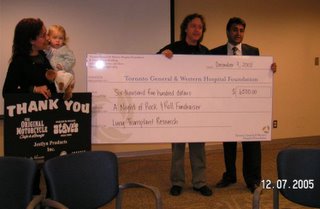
A highlight of the day was fundraising donations made to Dr. Shaf Keshavjee, Director, Lung Transplant Program, Toronto General Hospital. In this photo, lung transplant recipient Gerald Sutton, along with his wife Kathy Marceline and daughter Karleigh, are presenting a check for $6500 raised at their October 15h Rock N' Roll event for lung transplant research. Please see the separate post in Gerald & Kath's thank you letter below.
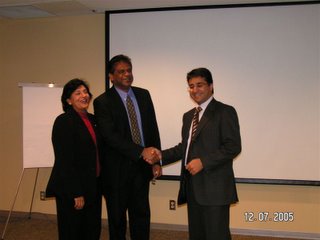 Here Dr. Shaf Keshavjee is receiving a donation of $5,000 from the Nirvana Cultural Society. These donations are fine examples of our transplant community "giving back". Fundraising activities are limited only by one's imagination and the Toronto General & Western Hospital Foundation will be very pleased to offer advice and guidance.
For information email:
Linda Ruickbie
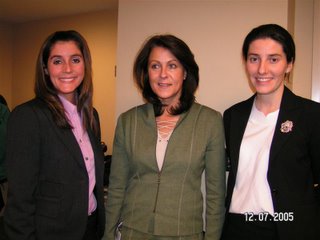 The Toronto General & Western Hospital Foundation was well represented and in this photo we have Claudia Vico, Linda Ruickbie and Mary-Claire Jankowski. The Hospital Foundation has been very supportive of our fundraising initiatives by providing their guidance, help and expertise.

A highlight of the day was fundraising donations made to Dr. Shaf Keshavjee, Director, Lung Transplant Program, Toronto General Hospital. In this photo, lung transplant recipient Gerald Sutton, along with his wife Kathy Marceline and daughter Karleigh, are presenting a check for $6500 raised at their October 15h Rock N' Roll event for lung transplant research. Please see the separate post in Gerald & Kath's thank you letter below.
 Here Dr. Shaf Keshavjee is receiving a donation of $5,000 from the Nirvana Cultural Society. These donations are fine examples of our transplant community "giving back". Fundraising activities are limited only by one's imagination and the Toronto General & Western Hospital Foundation will be very pleased to offer advice and guidance.
 For information email:
Linda Ruickbie
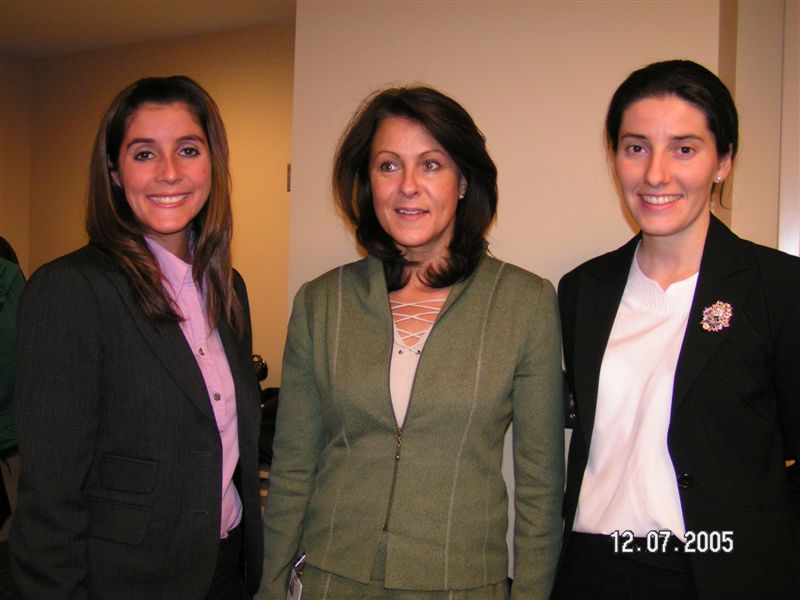 The Toronto General & Western Hospital Foundation was well represented and in this photo we have Claudia Vico, Linda Ruickbie and Mary-Claire Jankowski. The Hospital Foundation has been very supportive of our fundraising initiatives by providing their guidance, help and expertise.
Thanks for a Night of Rock 'N Roll
Transplant recipients are generally very grateful for their "second chance" and like to show their thanks by giving back. One of the ways to do this is raising money for transplant research and lung transplant recipient Gerald Sutton along with his wife Kathy Marcelline came up with a very creative initiative. Their letter below tells the story.
Dear Friends,
Saturday October 15, 2005, more than 200 attended A Night of Rock 'N' Roll at The Original Motorcycle Café & Lounge in support of Toronto General Hospital, Lung Transplant Research. Ticket sales, the raffle and donations raised over $6500!
Wednesday December 7, 2005, we had the enormous pleasure of presenting the cheque to the surgeon who performed Gerald's transplant in 2002, Dr. Shaf Keshavjee, Director, Lung Transplant Program, Toronto General Hospital. See photo
We are incredibly grateful to:
SPONSORS
Clevelands House, Muskoka
Jestlyn Products, Inc.
The Original Motorcycle Café & Lounge
Steve's Music Store
Tennis Canada
Toronto Argonauts
THE BANDS
The Well
Tyler Ellis Band
Last Call
Eugene Ripper
The Woodleys
Volunteers, and YOU for your support!
And we are forever grateful to Dr. Keshavjee, the entire Organ Transplant Team at Toronto General Hospital, and, the Donor Family.
Sincerely,
Gerald, Kathy and family
Dear Friends,
Saturday October 15, 2005, more than 200 attended A Night of Rock 'N' Roll at The Original Motorcycle Café & Lounge in support of Toronto General Hospital, Lung Transplant Research. Ticket sales, the raffle and donations raised over $6500!
Wednesday December 7, 2005, we had the enormous pleasure of presenting the cheque to the surgeon who performed Gerald's transplant in 2002, Dr. Shaf Keshavjee, Director, Lung Transplant Program, Toronto General Hospital. See photo
We are incredibly grateful to:
SPONSORS
Clevelands House, Muskoka
Jestlyn Products, Inc.
The Original Motorcycle Café & Lounge
Steve's Music Store
Tennis Canada
Toronto Argonauts
THE BANDS
The Well
Tyler Ellis Band
Last Call
Eugene Ripper
The Woodleys
Volunteers, and YOU for your support!
And we are forever grateful to Dr. Keshavjee, the entire Organ Transplant Team at Toronto General Hospital, and, the Donor Family.
Sincerely,
Gerald, Kathy and family
Friday, December 09, 2005
Snow Day in Waterloo
 Here's the view from my kitchen window this morning. I turned on the radio to hear nothing but news about traffic jams and accidents so I decided right then and there to make this a "Snow Day for Merv" and stay home to tackle the dreaded job of unpacking and settling into my new place in Waterloo, Ontario. Now that I've finally moved in I can resume regular posts to this blog. Stay tuned.
For my new address & phone number please email me:
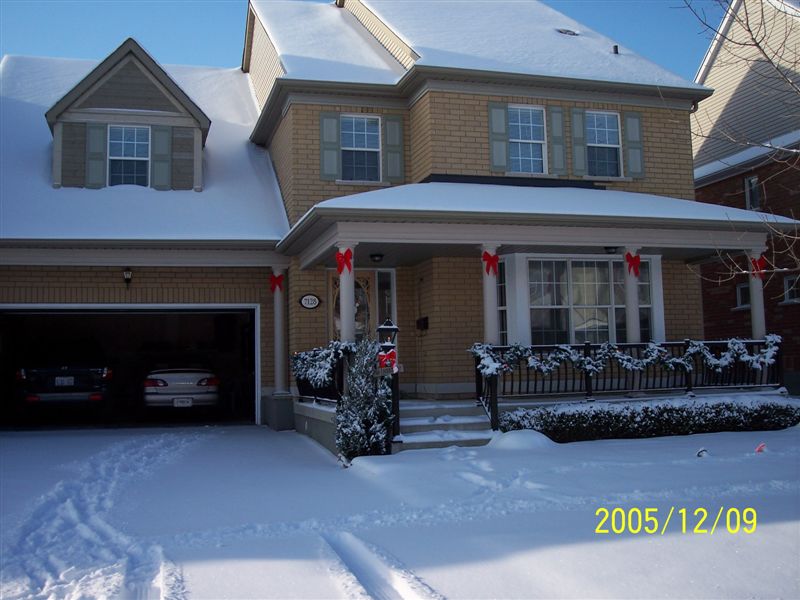
After reading the above, lung transplant recipient Peter Laurence sent in this photo of what he and his wife Lynne woke up to this morning in the Toronto suburb of Mississauga. Looks like a lot of us had a snow day today.
Subscribe to:
Posts (Atom)